
Question: In SB 5.17.1, the Ganges is described to originate from the water outside of the universe when the covering of the universe was pierced by the nail of the big toe of Lord Viṣṇu’s left feet. In Vālmīki Rāmāyaṇa (VR 1.35), Viśvāmitra told Prince Rāma that Ganges is the eldest daughter of Himavān, the king of the mountains. How the different origins of the Ganges can be harmonized?
Answer by Romapada Swami:
The Ganges as bhagavat–padī and as Haimavatī are two separate yet not conflicting events. The Ganges water as seen today could be linked to more than one origin.
In addition to the two origins mentioned above, there are others!
E.g. “You have some misunderstanding about the truth of Ganga. You said that Ganga is a devotee of Visnu in liquid form. But actually the Supreme Lord Himself has taken the liquid form of Ganga in order to deliver the living entities. The Puranas describe how one day Lord Narayana melted into liquid on hearing the singing of the five-headed Lord Siva. That divine water became the Ganges River, which is directly Transcendence in the form of water. Indeed, simply by remembering her name, one is freed from the cycle of birth and death. The Lord’s spiritual potency takes the form of Ganga.” [Advaita Prakäça, Chapter 6]
Ganga is thus both the Lord’s spiritual potency (who can manifest herself in various forms simultaneously), as well as a liquified form of Narayana Himself!
[c.f. Krsna Sandarbha Anuccheda 67 Text 3 “”The Supreme Personality of Godhead, Lord Janärdana, whose form is completely spiritual and who is always free from material contact, personally appears in the form of the water of the Ganges River. Of this there is no doubt.”]
Please consider the following.
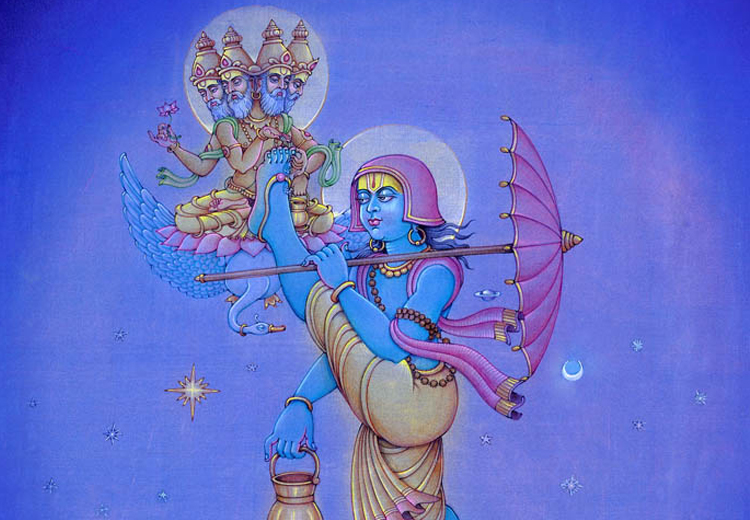
It is worth noticing two points in SB 5.17.1: 1) after entering the universe through the hole pierced by Lord Viṣṇu (Lord Vāmana), it took a long time (ati–mahatā kālena) consisting of a thousand millenniums (yuga–sahasra–upalakṣaṇena) for the Ganges to reach Viṣṇu-pada (Dhruva-loka); 2) for this reason the Ganges was called bhagavat–padī and was not known by any other name at that time.
In the context of cosmic time, the phrase yuga-sahasra is often taken as one thousand four-yuga cycles, i.e., the duration of Lord Brahmā’s daytime or nighttime (e.g., Bg 8.17, SB 3.11.22). Given that the seventh manvantara is current, it would take us back to the previous kalpa to accommodate a daytime or nighttime of Lord Brahmā. If yuga is taken as a one of the four ages (satya, tretā, dvāpara, or kali), one thousand yugas would amount to 100 to 400 four-yuga cycles, i.e., 1.4 to 5.6 manvantaras. The word yuga can also mean a period of five years. Considering that “a long time” is particularly stated in SB 5.17.1, it may be more direct to take yuga as one of the four ages or a cycle of four ages.
In terms of Lord Vāmana’s appearance, while SB primarily makes reference to His appearance to Bali Mahārāja, since this appearance occurred in the current manvantara (SB 8.13.6), based on the above discussion on yuga it may be inferred that this appearance is after Lord Vāmana piercing the covering of the universe. According to LB (1.3.73), “Vāmana appears three times in the day of Brahmā. The first time, during the Svāyambhuva Manvantara, he went to the sacrifice of the king of the demons called Vāskali. During the Vaivasvata Manvantara he went to the sacrifice of Dhundhu. In the seventh yuga cycle of Vaivasvata Manvantara, he was born to Aditi and Kaśyapa. The three forms appeared in order to give away the land that they had begged.”
In relation to the above inference, according to SB, during Lord Vāmana’s appearance to Bali Mahārāja, His second step reached Brahmaloka, and Lord Brahmā along with great personalities offered worship. Yet Lord Vāmana piercing the covering of the universe is not mentioned. Instead, SB 8.21.4 describes that the water from Lord Brahmā’s kamaṇḍalu purified by washing the lotus feet of Lord Vāmana, became the water of the Ganges. Viśvanātha Cakravarti Ṭhākura commented, “The water from his pot became purified by washing the Lord’s feet and then became the Gaṅgā. However, in the Fifth Canto it is mentioned that the Gaṅgā arose from the water outside the universal shell, which was pierced by Vāmana’s toenail. Elsewhere it is said that the Gaṅgā is directly a liquid form of Nārāyaṇa. It should thus be understood that all three of these mix and become the Gaṅgā. This Gaṅgā falls (patatī should be patantī) in the sky and purifies (nimārṣṭi) the three worlds.” (Sārārtha Darṣinī 8.21.4) Lord Vāmana’s appearance to Bali Mahārāja is also described in VR 1.29. Likewise, His piercing the covering of the universe is not mentioned in that account.
The second point from SB 5.17.1 indicates that the name of the Ganges as Himavān’s daughter (Haimavatī, VR 1.42.23) is not known at the time when the Ganges originated from outside the universe. This implies that the Ganges appearing as Himavān’s daughter is also a later event.
In addition, according to Viśvāmitra’s narration in VR 1.35, the Ganges as Himavān’s daughter is related to her flowing in three courses (in the sky, on the earth, in the nether regions) (Note: the Ganges having three courses is also mentioned in SB 10.70.44). From a narrow perspective, these three realms (i.e., heavenly, earthly, subterrain) do not include the higher realms starting from Mahar-loka. In this sense, the Ganges’ flowing through the higher realms when descending from outside the universe and the Ganges’ flowing in three courses are spatially separate. As a note, SB 5.17.4 states that the Ganges is carried through the spaceways of the demigods, i.e., the heavenly realm, by celestial airplanes.
Again, to sum, the Ganges as bhagavat–padī and as Haimavatī are two separate yet not conflicting events. The Ganges water as seen today could be linked to more than one origin.