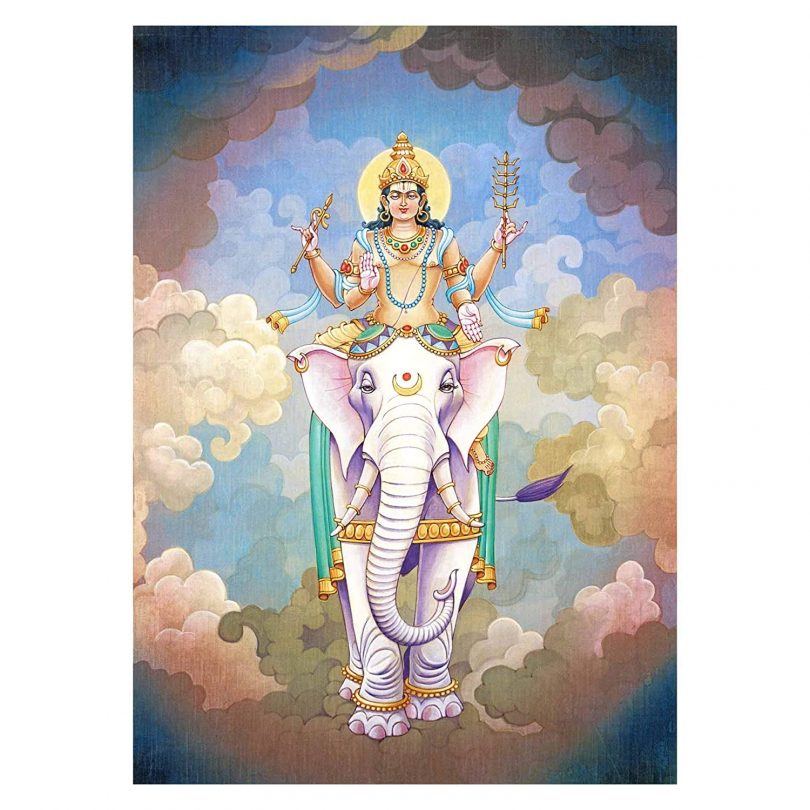

Question: SB 8.5.15 indicates that the narration regarding the churning of the Milk Ocean commenced with the initial description of Indra’s decorating the trunk of Airavata with Durvasa Muni’s garland. Later, SB 8.8.4 identifies Airavata as being produced from the churning. How to understand this?
Answer by Radhika Raman prabhu1:
The following thoughts are rather general and inconclusive, without providing detailed references to these specific events.
Vaisnava cosmology views time as a kala chakra, the wheel of time.
Regarding sequencing issues in lilas found within Srimad Bhagavatam or Caitanya Caritamrita or the Puranas in general, it is very important to remember that the Puranas are not presenting history in a sequential fashion, because the Puranas do not subscribe to a linear notion of history, or of time in general. Puranic history doesn’t simply run unidirectionally from past to present to future. Rather, Vedic time is cyclical in nature, where similar events and large cycles of time are repeating themselves over the course of history. Thus, when we think of time in a linear fashion – e.g. something that happens before seems to be described after, or something that should have happened before – this is not how events are described in the Puranas. When these sorts of things happen out of order, they become very confusing to us because we are products of study and culture that privileges linear understandings of time.
Srimad Bhagavatam and other Vaisnava literature, as well as Vedic literature in general, are attempting to provide history for a different purpose: not for laying upon a timeline, but for the purpose of development of the spiritual advancement of the reader. Srimad Bhagavatam is laid out very sequentially from that perspective.
From the first canto to the tenth, one can gradually progress in one’s spiritual understanding to the highest levels of bhakti. SB is sequential, but for a different purpose. When we attempt to put a historical timeline in the way that history is conceived in a linear framework, we can become quite confused, or find it challenging to believe or to understand.
However, the acaryas occasionally do attempt to parse out the chronology. They don’t give too much attention to this, but sometimes when those issues become particularly difficult, or it’s useful for us to better understand the sequence of Krishna’s pastimes for the purposes of meditation, then they sometimes parse out the ordering of things.
Occasionally, when that parsing doesn’t work in one cycle of time, then they will resort to the idea of kalpa-bheda, i.e. a difference in kalpas, or different days of Brahma. An event may have happened in Brahma’s previous day, or in a previous cycle of the universe itself. What comes before and what comes after is very difficult to understand if you’re on the points of a circle. Imagine a circle. Pick a point on that circle, and then pick a second point on that circle. Chronologically, which one comes before, and which one comes after? From the perimeter of that circle, that would be impossible to say. For the same reason, the acaryas explain that ‘chronological discrepancies’ may be an example of kalpa-bheda – as time moves in a cyclical fashion. A particular event may have happened in a previous age and another event may have happened in a later age. This is one way we can understand factual chronological contradictions.
Details related to this particular lila (Adi Purusha Prabhu):
Neither the sloka nor SP’s commentary mention Airavata, just an “elephant” ridden by Indra. So our BBT SB creates no contradiction.
However, Airavata is mentioned in Sri Visvanatha Cakravarti Thakur’s commentary, which follows a lengthy citation from Sridhar Swami. In other Vedic texts, Indra’s elephant is named Airavata in this and other Puranic stories, even before the Samudra-manthana.